What Sorting LEGO Bricks Can Teach Us About AI
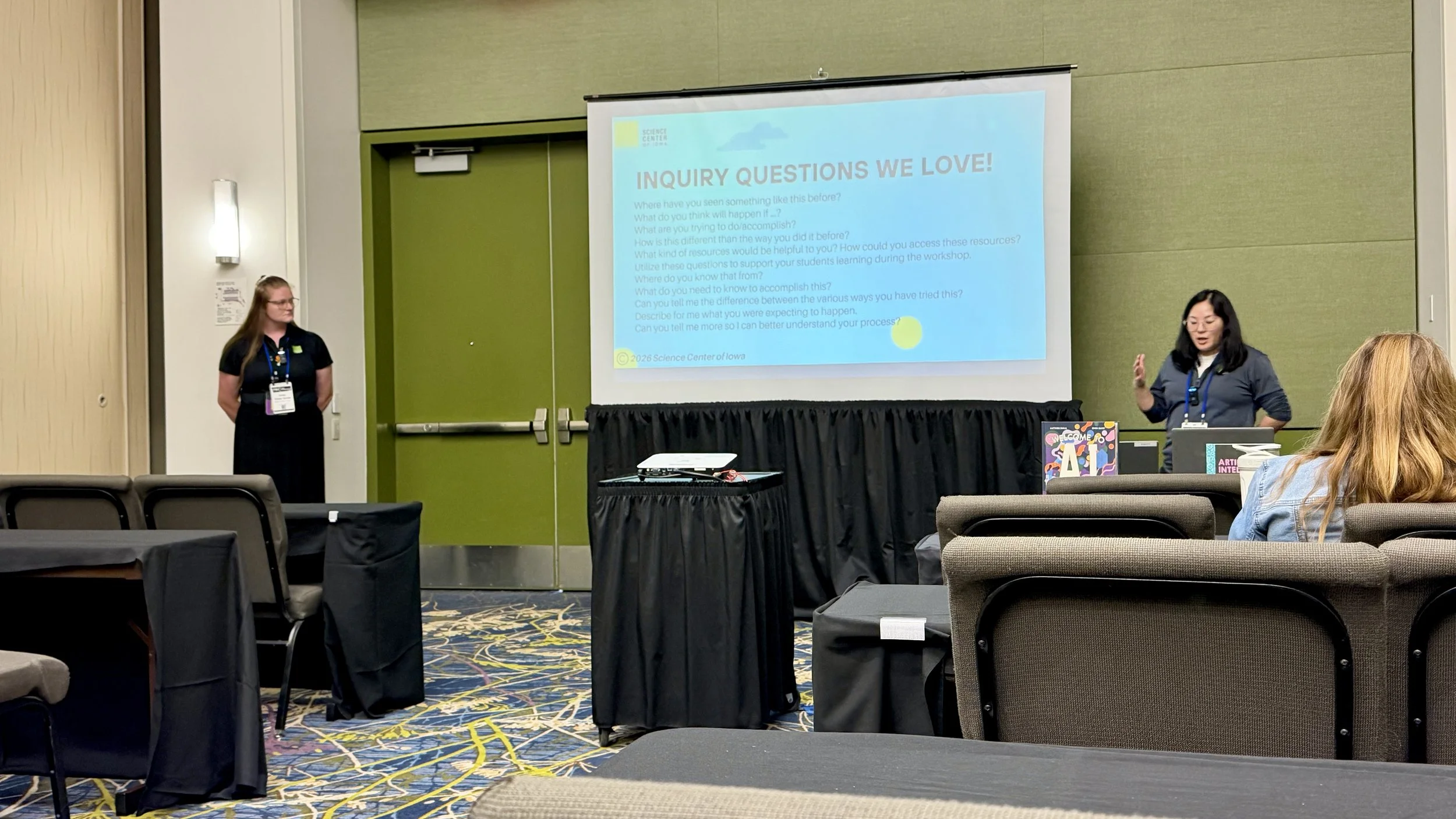
What can a bag of LEGO bricks teach us about artificial intelligence? Quite a bit, as I learned during “Teaching Inquiry Skills That Help Humans and AI Think Better Together,” a hands-on session at the ITEC Fall Conference led by Raymi Choate and Lindy Trout Turnis of the Science Center of Iowa.
Raymi and Lindy wanted educators to think about two connected questions: What makes us uniquely human, and what can AI do well? Through a couple of hands-on activities, they showed how understanding the strengths of humans and AI can help us make better decisions about when to use each.
What Should We Automate?
The session began with an activity called Most Uniquely Human. Small groups received cards with words describing different abilities and characteristics. Their job was to arrange the cards along a spectrum, from what they considered most uniquely human to least uniquely human.
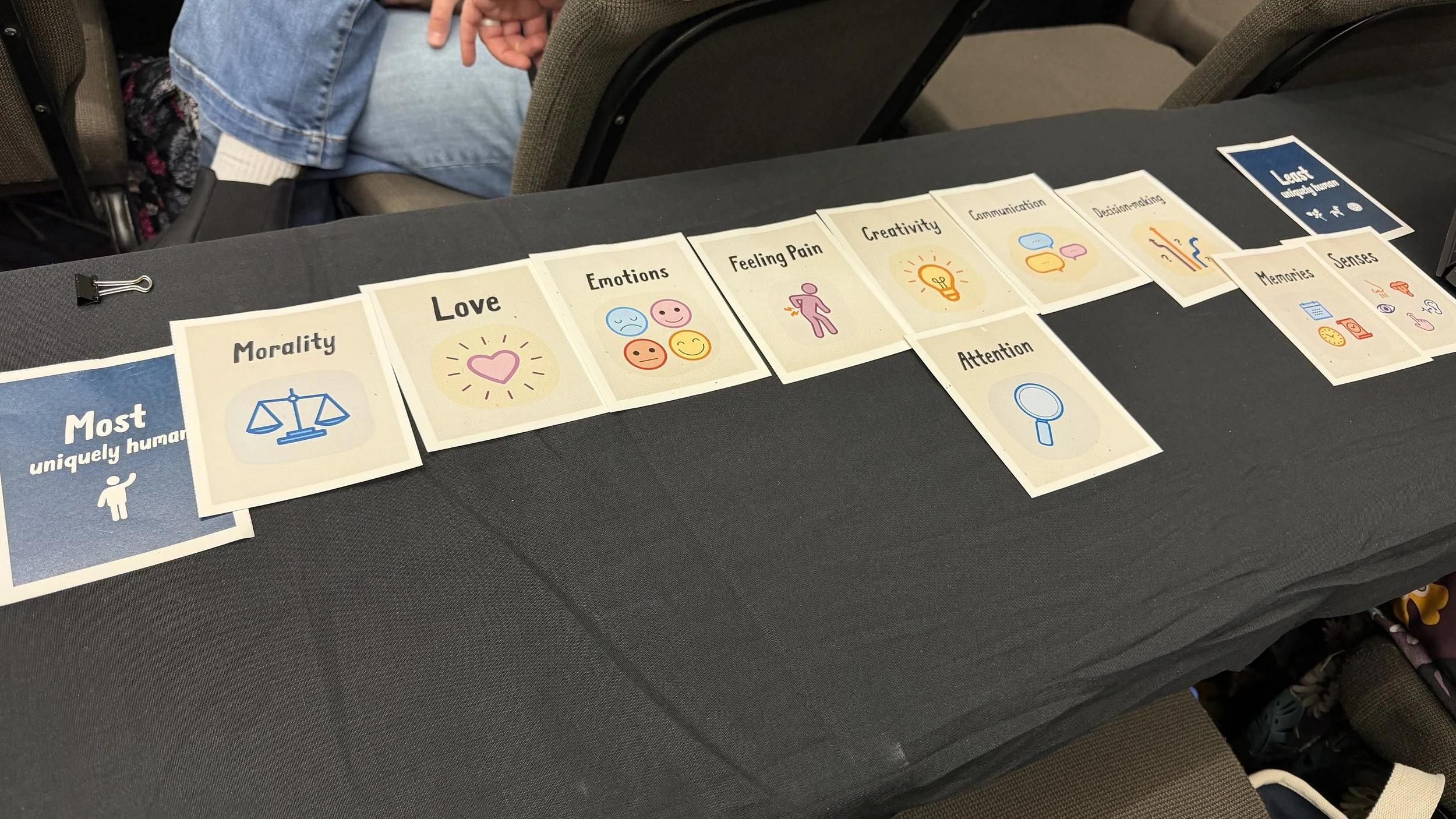
The conversations were interesting. Where should creativity go? What about memory, attention, communication, and emotions? Could a computer or another animal demonstrate some of these abilities, even if not in the same way a human does?
There were no right answers. The point was to examine our assumptions and consider what separates human abilities from tasks a machine can perform.
Raymi and Lindy connected the activity to a practical principle: When deciding what to automate, look first at tasks that don't depend on the things that make human relationships and experiences valuable.
Computers can be excellent at processing information, recognizing patterns, and organizing data. Automating those tasks can free people to spend more time on work that benefits from human connection, care, judgment, and collaboration.
Raymi shared an example of children who say they'd like to build a robot that could be their friend. She challenged that idea. Friendship involves more than communicating or remembering someone's favorite color. It involves human connection and the feeling of being known and understood.
The goal isn't to automate everything we possibly can. It's to consider what we gain, what we might lose, and where human involvement matters most.
That idea set the stage for the next activity.
A Bag of LEGO Bricks and a Multidimensional Problem
Each table received a bag of LEGO bricks. First, we had to organize them by color, placing similar bricks near one another. Then we added a second criterion, such as size or the number of studs. Finally, we introduced a third.
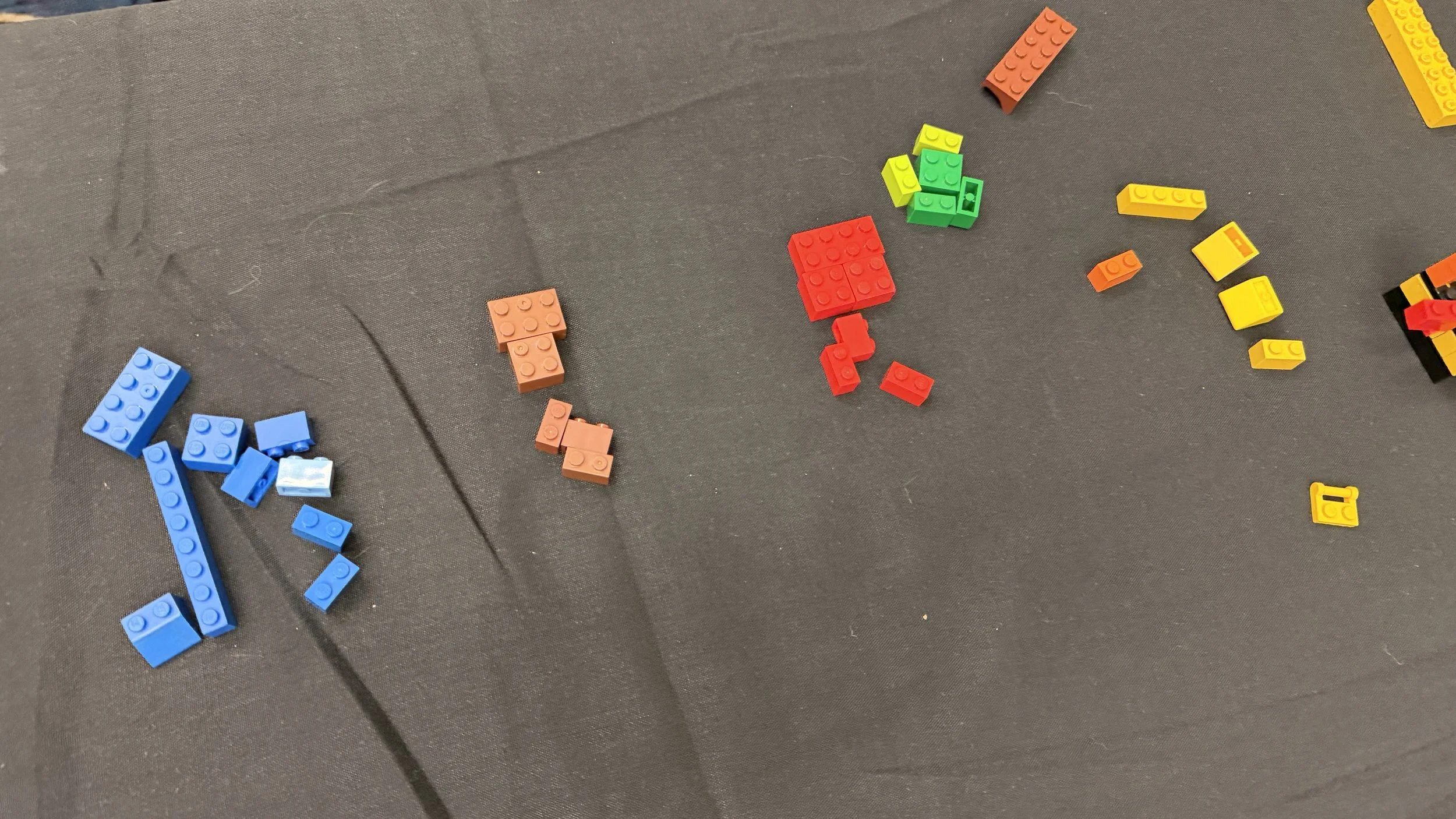
What started as a simple sorting task quickly became challenging. How do you arrange bricks so that multiple characteristics are represented at once? A brick might be similar to another in color but different in size. Which relationship should take priority? This made my brain hurt.
The activity demonstrated how difficult it can be for humans to organize information across multiple dimensions. We tend to focus on the most obvious features, and accounting for several characteristics at once takes effort.
Computers are well suited to this kind of work. They can process many numerical features and identify relationships that would be difficult for us to see.
This is where the LEGO activity connected directly to AI.
How AI Organizes Information
In AI, an embedding is a numerical representation of data that captures aspects of its content or meaning. An embedding can be represented as a vector, essentially a list of numbers. AI systems can compare these vectors to identify relationships among pieces of data.
Think of the LEGO bricks on our tables. Similar bricks were placed near one another, creating neighborhoods of similarity. Embeddings work on a related principle: data represented by similar vectors tends to be closer together in an embedding space.
Real embeddings are much more complex than our LEGO arrangements. They can contain hundreds or thousands of dimensions, and the relationships they represent aren't necessarily characteristics we could name or see. Still, the activity gave us a tangible way to picture how AI can organize information and identify patterns across many dimensions.
Raymi and Lindy then asked us to imagine we were the AI. Using descriptions of the LEGO pieces and the relationships we'd identified, we had to construct a response to a LEGO creation Lindy had made.
Different groups made different connections. One group focused on contrasts between light and dark, while another connected its arrangement to a bridge.
We were using the data available to us to make connections and produce something that might serve as a response. That helped illustrate an important distinction: AI doesn't process language and understand the world through human experience. Generative AI models use tokens, context, and patterns learned from data to predict and produce responses.
Embeddings are one part of this larger process, not a complete explanation of how a chatbot or image generator works. But they help explain how relationships among pieces of data can contribute to a response.
AI can produce a response that sounds like understanding without understanding in the same way a human does.
What This Means for Students
These activities offered a useful way to introduce students to how AI works without requiring them to learn the mathematics behind it.
Students can experience the difficulty of sorting information across multiple dimensions, then consider how computers can do this kind of work at a scale that's difficult for humans. They can also explore how different interpretations of the same information can lead to different conclusions.
Most importantly, the activities connect a technical concept to a bigger question: What should we ask AI to do, and what should we keep for ourselves?
If AI can sort, classify, and find patterns in data, those may be reasonable tasks to automate when doing so serves a worthwhile purpose. But efficiency shouldn't be the only consideration. We also need to think about the human skills we want students to develop and the experiences we don't want technology to replace.
Raymi and Lindy tied this back to inquiry-based learning. At the Science Center of Iowa, they encourage students to ask questions such as, “What have you tried?” and “What are you trying to accomplish?” Rather than jumping in with answers, educators help students figure out what they know, what they need to know, and how they might find out.
That approach is valuable when students work with AI, too. They need to ask thoughtful questions, provide relevant context, evaluate the responses they receive, and be willing to test their assumptions. They also need opportunities to struggle, experiment, and learn from mistakes rather than having technology do all the thinking for them.
Choosing What to Keep Human
I appreciated how Raymi and Lindy connected a technical concept like embeddings to a question that matters in every classroom: What do we want people to do, and what can we reasonably ask technology to do for us?
The LEGO activity made multidimensional data organization visible. The card-sorting activity helped us consider whether that kind of work is uniquely human in the first place. Together, they illustrated why AI literacy involves more than learning how to use a chatbot.
Students need to understand what AI is good at, what its limitations are, and how to make thoughtful choices about using it. They also need to recognize the value of the human abilities we should continue to nurture.
AI can help us process information and find patterns. That doesn't mean it should replace the human experiences, relationships, and judgment that give our work meaning.
The challenge isn't to automate as much as possible. It's to use AI where it helps while protecting the things we most want to remain human.
This post was drafted by ChatGPT based on my notes and presentation transcript.